103
Pages
10 dashboards, 23 applications, 16 e-commerce screens
 AdminVora
v1.0.1 108 pages · 239 components · out now
108 finished screens in plain HTML, vanilla JavaScript and token-driven SCSS, ready for Laravel, Django, CodeIgniter, Rails or plain PHP. 13 themes with their own personality, light and dark, right-to-left throughout. No framework to adopt, no build step to inherit, and nothing fetched from a CDN, ever.
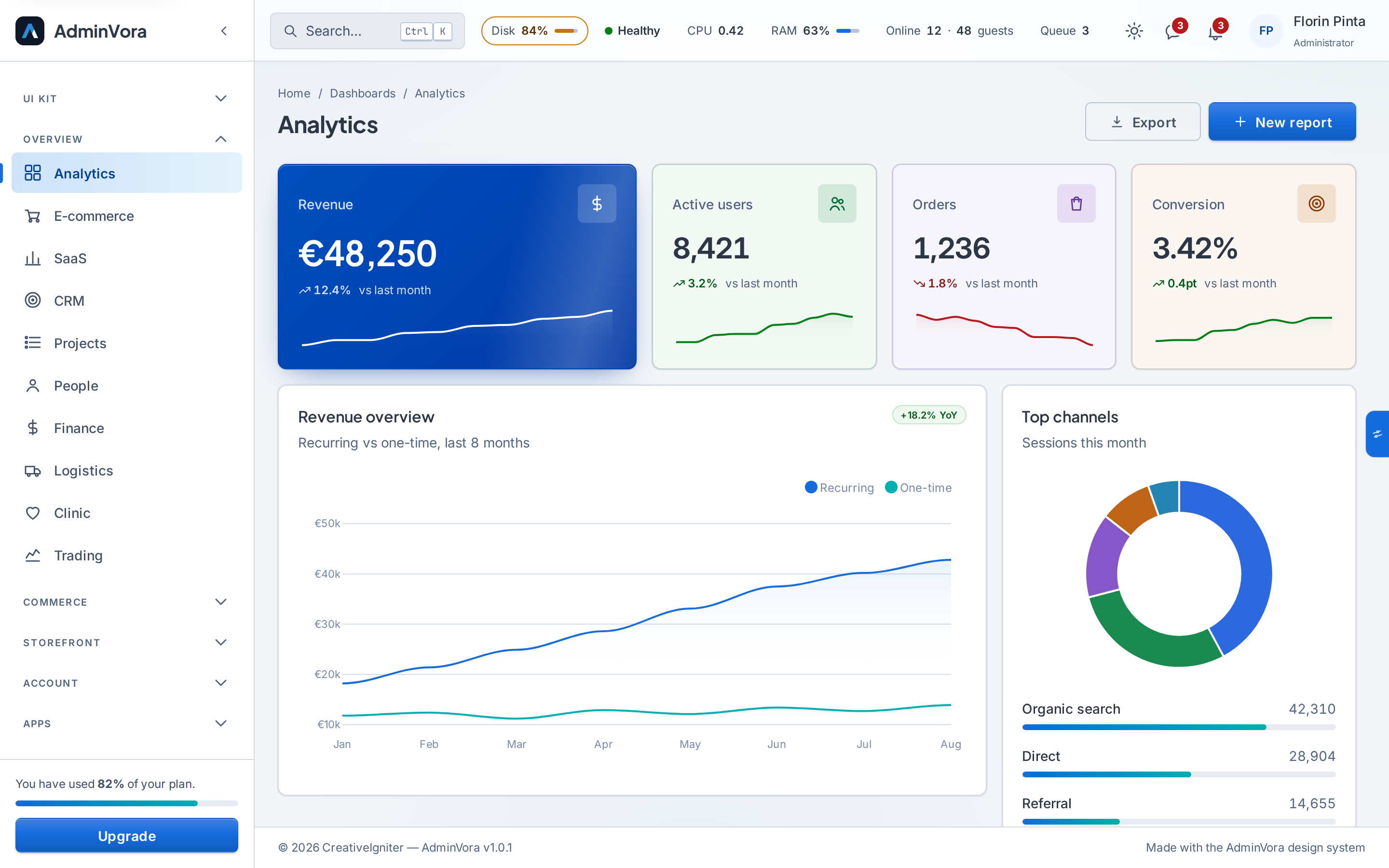
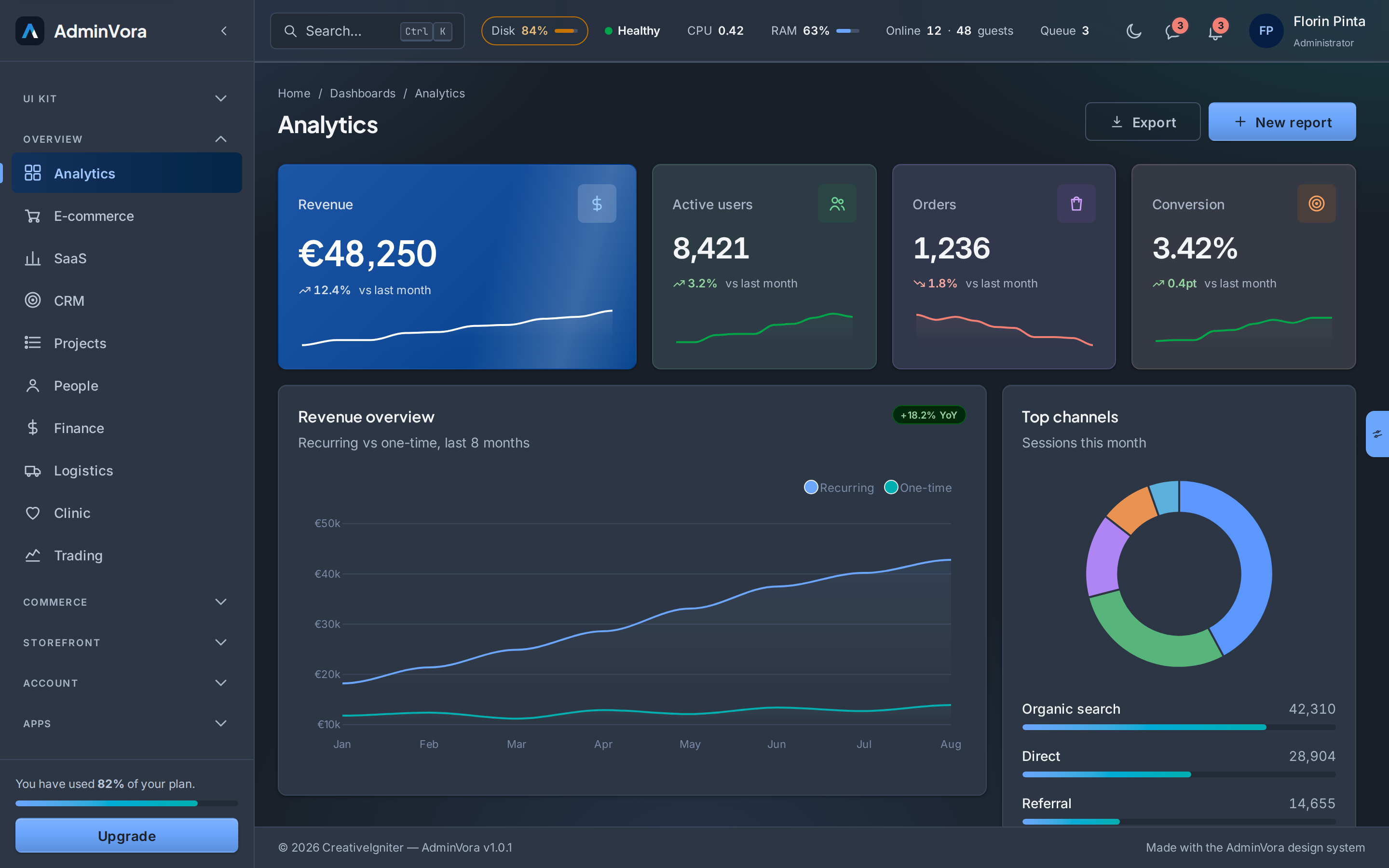
Ships with a starter kit for
13 presets, each drawn here in its own colours. Each one changes the palette, the
greys, the surfaces, the corners, the headings and the charts, not only the button
colour. Pick one and this page re-skins while you read it. Theming is attributes on <html> selecting custom
properties, so no theme code sits in the render path and there is no flash on load.
Every figure below is something you can count in the download. Nothing here is a roadmap.
103
Pages
10 dashboards, 23 applications, 16 e-commerce screens
224
Components
Each documented, each in its own SCSS partial
8
Starter kits
Static, Laravel, Django, Express, React, Vue, Next, Nuxt
87
Docs pages
Searchable, and readable straight off the filesystem
16
Themes
Light and dark, every one contrast-checked
0
External requests
Every dependency vendored into the folder
An admin template is mostly a set of choices somebody already argued about. These are the ones that will matter to you in month three, not on the first afternoon.
The runtime is one vanilla-JavaScript file. Open a page from the filesystem and it
works. Nothing assumes a bundler, a node_modules, or a version of React.
Mode, preset, density, radius and depth are attributes on <html>
selecting custom properties. One attribute re-skins every screen at once, and no theme
code sits in the render path.
All ten third-party libraries are copied into the folder and checksummed. No CDN, no analytics, no font service. It runs on an air-gapped network because that was a requirement, not an accident.
Every page runs through axe against WCAG 2.1 AA in both colour modes, and all 13 presets are contrast-tested from the browser's own computed styles rather than from the palette that produced them.
Logical properties everywhere, and a lint rule that refuses a transform whose direction cannot flip. RTL is asserted on every page, not offered as a variant somebody has to maintain.
75 pages of documentation, shipped inside the download with relative URLs, so double-clicking
index.html works. No server needed to read how something is put together.
Every claim on this page is enforced by something that fails the build when it stops being true. These are the ones worth naming.
Every page opened in a real browser, both colour modes, checked for console errors, horizontal overflow at 320px, and any request leaving the origin.
Every page and mode compared against a recorded baseline, with the clock, timezone and locale pinned so a chart cannot drift the diff on its own.
Contrast asserted at 4.5:1 from getComputedStyle, not from the generator:
its maths clamps out-of-gamut colour and can disagree with the browser.
A lint rule fails the build on any data-av-* hook in the markup that
nothing reads. A control that renders, takes focus and does nothing is worse than no
control at all.
All ten libraries copied in and SHA-256'd against a manifest. An updated dependency is a deliberate act with a diff, not something that changed overnight.
The artefacts you download are unpacked by an unzip that is not ours, served, and checked to boot with nothing fetched from outside the folder.
Components are claimed by a data-av-* hook and bound at boot. Nothing to
register, nothing to import, and nothing that breaks when your bundler changes its mind.
Wiring guides for Laravel,
Django,
CodeIgniter and
plain PHP.
<!-- a data grid: sorted, filtered, paginated -->
<table data-av-datagrid
       data-av-grid-noun="order">
  <!-- your server-rendered rows -->
</table>

<!-- a chart; the vendor loads on demand -->
<div data-av-chart="area"
     data-av-chart-series="[12,19,14,22]"></div>

<!-- re-scan after a client-side route change -->
<script>AdminVora.init(root)</script>
Heavy vendors load only when a page actually uses them: a page with no chart never
fetches the charting library, and a test asserts it in both directions. Server-rendered
content is enhanced, not replaced: the grid reads the rows already in your
HTML, and AdminVora.destroy(root) hands them back.
That is the whole integration story. It is why the same markup drops into a Laravel Blade template, a Django template, a React component and a plain file without a translation layer in between.
Every tier receives exactly the same contents. The tier decides what you may build with them, never which files you get.
NOTICE.md listing every third-party component and
the licence it travels under.
Ten libraries, all of them local
The demo is the product: the same pages, the same stylesheet, the same runtime you receive. Nothing on it is a mock-up.